Sierra Primrose
Primula suffrutescens · Primulaceae
- Form
- Subshrub
- Height
- 4–8 in
- Sun
- Full Sun
- Water
- Moderate
- Blooms
- Jul, Aug
🌿 California native
Quick facts
- Habitat: High granite crevices, talus, and snowmelt seeps of the Subalpine and alpine crest
- Form / size: Woody-based mat, 4–8 in
- Sun: Full sun · Water: Moderate (late snowmelt)
- Blooms: Bright magenta with a yellow throat, July–August · Pollinator value: Moderate
Description
A splash of hot magenta on bare high granite, and one of the Sierra’s signature alpine flowers. Sierra primrose is a mat-forming subshrub anchored by a stout woody rhizome clothed in the dried remains of past seasons’ leaves. Its hairless, spoon-shaped leaves, with jagged teeth clustered at the blunt tip, are held in low basal rosettes. From these rise short leafless stalks carrying umbels of up to about nine flat, forward-facing magenta flowers roughly an inch across, each with five notch-tipped lobes and a contrasting yellow throat. The whole plant hugs the rock, splashing rose across the grey well above treeline.
Ecological role
Sierra primrose is a high-elevation crevice specialist, growing on north- and east-facing granite where late snowmelt keeps the cracks moist through its short July-to-August bloom. Its woody base and thatch of old leaves buffer the crown against wind, drought, and the freeze-and-thaw of the alpine zone. Restricted to granitic screes, talus, and rock cracks near and above treeline, it is a plant of the Sierra crest rather than a wide-ranging generalist, and its flowers draw the bumblebees and solitary bees that work the short alpine summer.
Habitat & range
A California endemic of the high Sierra Nevada crest (with disjunct populations in the Klamath Ranges), in granite crevices, talus, and snowmelt seeps, roughly 7,900 to 12,800 ft. It grows around Lake Tahoe (documented in Tahoe National Forest and the surrounding high country) and through the Eastern Sierra high peaks near Mammoth Lakes south to the Kearsarge Pass and Mount Whitney country.
In the garden
A prized but notoriously difficult alpine and rock-garden plant, essentially a collector’s subject rather than a mainstream native. It needs a gritty, sharply drained granitic mix, cool roots kept moist in the snowmelt style, and no summer waterlogging, and it rarely thrives much below its native elevation. It is essentially unavailable in the California nursery trade.
Propagation
From seed, which, like other alpine primulas, germinates best after cold-moist stratification; sow it cool and keep it from drying. Established mats can be increased by careful division of the woody rootstock or by rooting rosette offsets. Success in cultivation hinges on cold winters, sharp drainage, and cool summer roots.
Where to see it near you
- iNaturalist — observed across California (map)
- High granite above Lake Tahoe and the Eastern Sierra crest (Kearsarge Pass, the Mammoth high peaks).
Sources
Commonly confused with
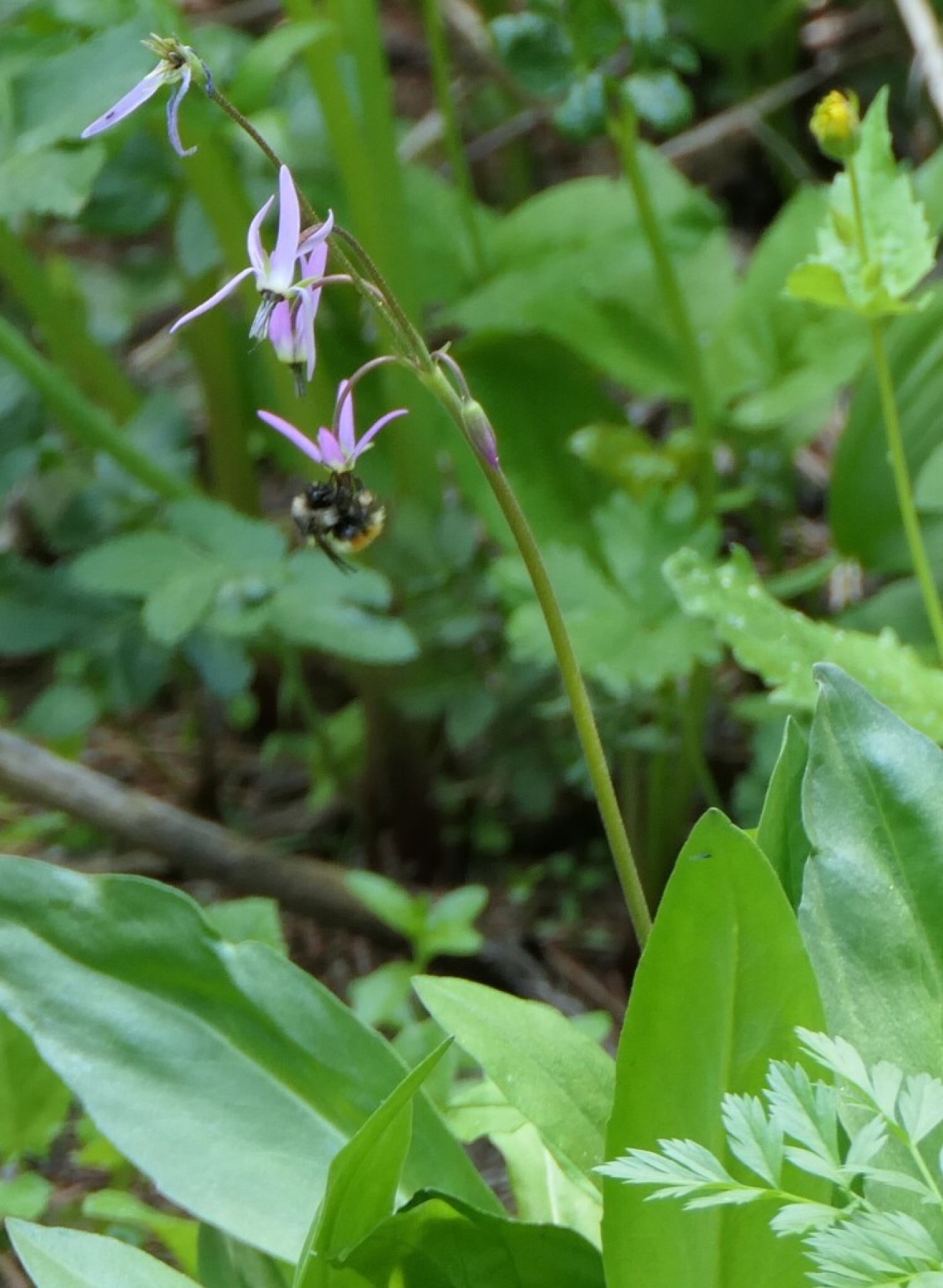 Sierra Shooting Star 🌿 Primula jeffreyi their petals sweep sharply backward like a shuttlecock. Sierra primrose petals lie flat and face outward.