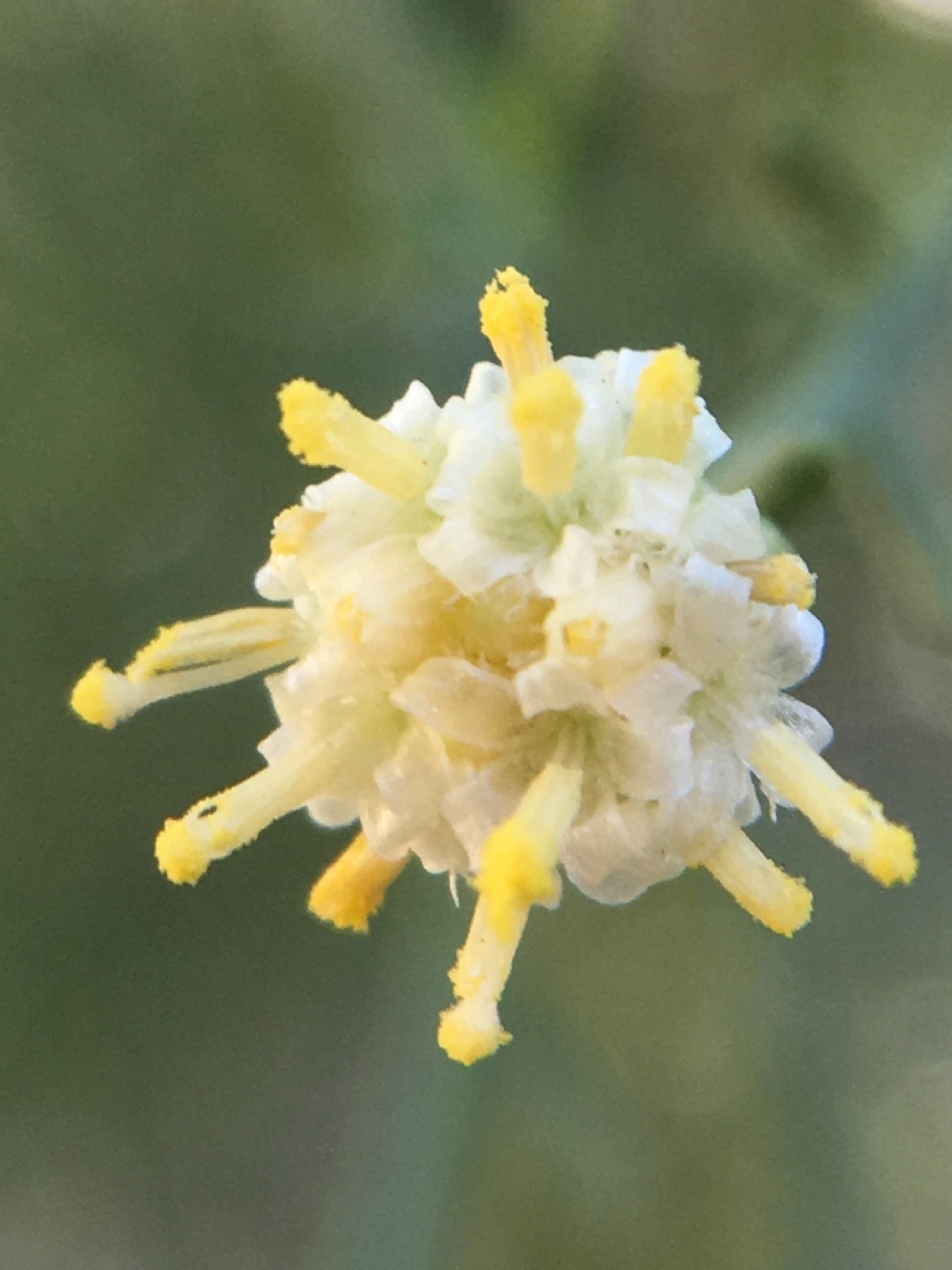
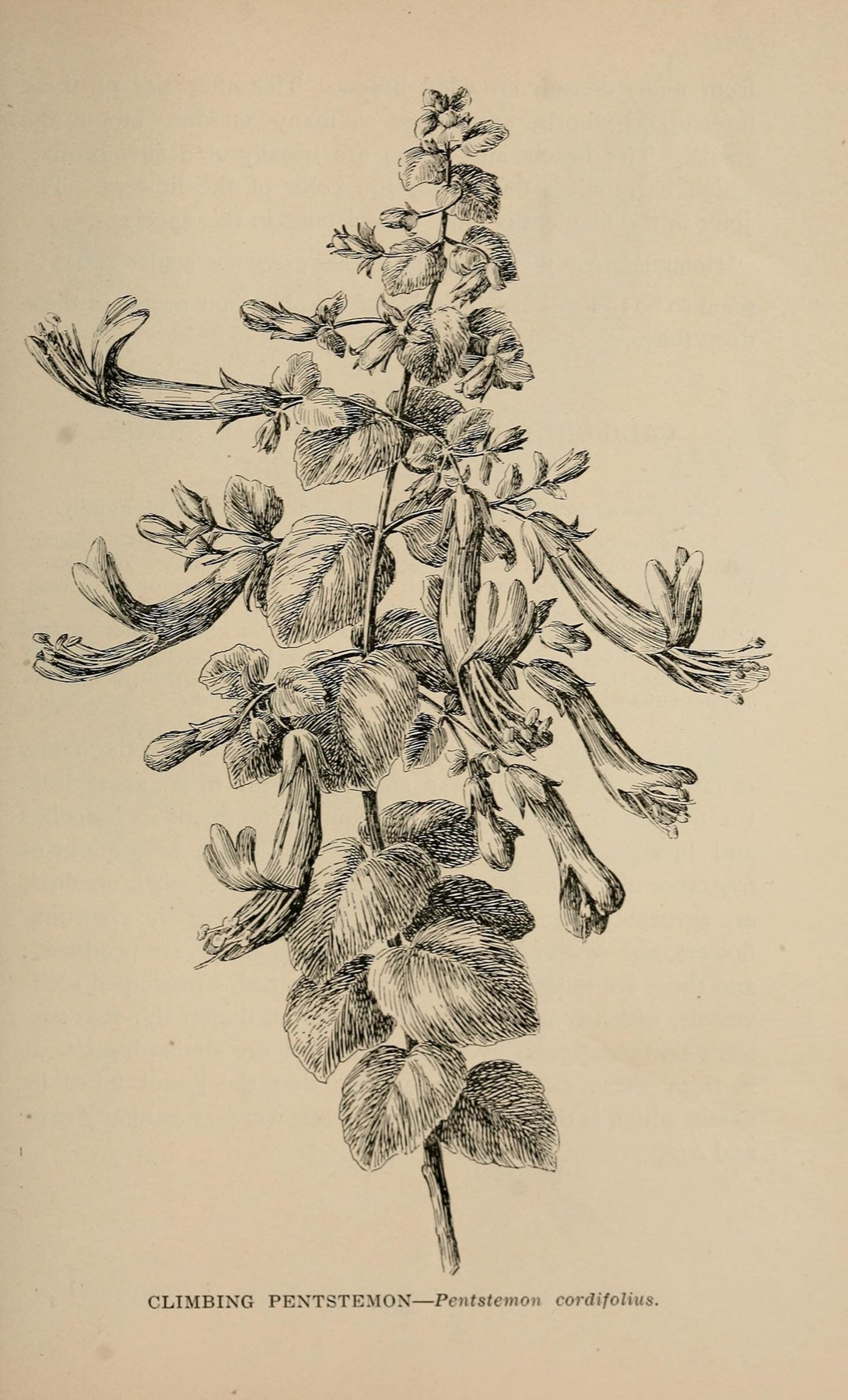
Sacred Datura
Datura wrightii · Solanaceae
- Form
- Perennial
- Height
- 1–3 ft tall, spreading 3–6 ft
- Sun
- Full Sun
- Water
- Low
- Blooms
- May, Jun, Jul, Aug, Sep, Oct
- Pet toxicity
- Toxic
🌿 California native
Highly toxic — all parts Every part of this plant contains tropane alkaloids (scopolamine, atropine) and is dangerously poisonous if ingested; ingestions can be fatal. Don’t taste it, keep it away from children, pets, and livestock, and wash your hands after handling. Admire it; don’t experiment with it.
Quick facts · Habitat: Sandy washes, disturbed open ground, Riparian edges, Desert · Form / size: Sprawling perennial, 1–3 ft tall × 3–6 ft wide · Sun: Full sun · Water: Low · Blooms: Summer–fall, opening at dusk
Description
A bold, sprawling native with large, soft, grey-green triangular leaves and spectacular white (lavender-tinged) trumpet flowers up to 6–8 inches long that open in the evening and wilt by midday. Fertilized flowers become round, spiny seed capsules (“thornapple”). Native, but a plant to respect — see the toxicity warning above.
Indigenous & historical use
This plant carried real spiritual weight for Southern California’s Indigenous peoples, and it still does. The Tongva called it manit; Spanish colonizers and later Mexican settlers picked up a name still used today, toloache. The Chumash to the north called it momoy and treated it as a person, not just a plant. In Chumash cosmology, an old woman named Momoy turned herself into datura after a great flood. Ethnographer Richard Applegate’s primary research on Chumash Datura use found that both men and women took it on their own initiative, any time after puberty, prepared by a relative — often a mother or grandmother — or by a specialist if it was someone’s first time. It was never built into a fixed initiation rite; some took it once, others returned to it later for medicine or in a crisis.
Further south, under the Chingichngish religious tradition practiced by the Gabrielino/Tongva, Luiseño, and Acjachemen (Juaneño), whose territories reach across coastal and, for the Acjachemen and Luiseño, inland Orange County, the practice was formalized into a boys’ coming-of-age ceremony. Boys from the same clan drank a dose prepared by a trained specialist from the pounded root, then slept while the community sang and waited; elders later read their visions as a guide to a guardian spirit and a life path. The dosing was precise, and the plant did not forgive a bad guess. Deaths were not unknown. That risk is part of why the knowledge stayed with people who had done it before, rather than something a family worked out on its own.
Ecological role
Sacred datura runs on a different clock than most of the plants around it. The flowers open at dusk and close by midday, timed to hawkmoths, especially the Carolina sphinx moth (Manduca sexta), which hover in front of the trumpet like a hummingbird and unspool a proboscis several inches long to reach the nectar at the bottom. Bees will visit by day if a flower is still open, but they’re an afterthought. Newly opened flowers vent a plume of humidity and carbon dioxide, and researchers have shown hawkmoths read that plume as a signal that a flower is fresh and worth the trip, not just relying on scent and the pale color that shows up in low light. The same Manduca sexta that pollinates the flowers also lays its eggs on the foliage. Its caterpillars — full-grown ones are fat, green, and startling, closer to a small snake than a bug — eat the leaves. The plant needs the moth to reproduce and feeds it as a nursery at the same time. That trade only works because sacred datura is loaded with tropane alkaloids that keep most other herbivores off it entirely. The hornworm is one of the few animals built to handle the chemistry.
Habitat & range
Common in sandy, disturbed, open places — washes, roadsides, riverbeds — across the Southwest, including the Trabuco Creek wash.
In the garden
A dramatic, fragrant night-blooming accent for dry gardens where its toxicity is not a hazard (no young kids/pets grazing). Full sun, lean soil, little water. It can reseed enthusiastically.
Propagation
From seed — sow in spring; soaking or light scarification improves germination. Established plants resprout from a deep perennial root each year. Handle seed and plants with care (toxic).
Where to see it near you
- iNaturalist — observed in Orange County
- Sandy washes and disturbed open ground.
Sources
- Calscape · iNaturalist · Wikipedia
- Ecological role: A signal-like role for floral humidity in a nocturnal pollination system (PMC) · Manduca sexta — Wikipedia
- Indigenous use: The Ethnobotanical Assembly — Toloache, Datura wrightii (Chumash momoy tradition, Timbrook) · Applegate, “The Datura Cult Among the Chumash,” Journal of California Anthropology 2(1), 1975 · Native American Ethnobotany Database
Commonly confused with
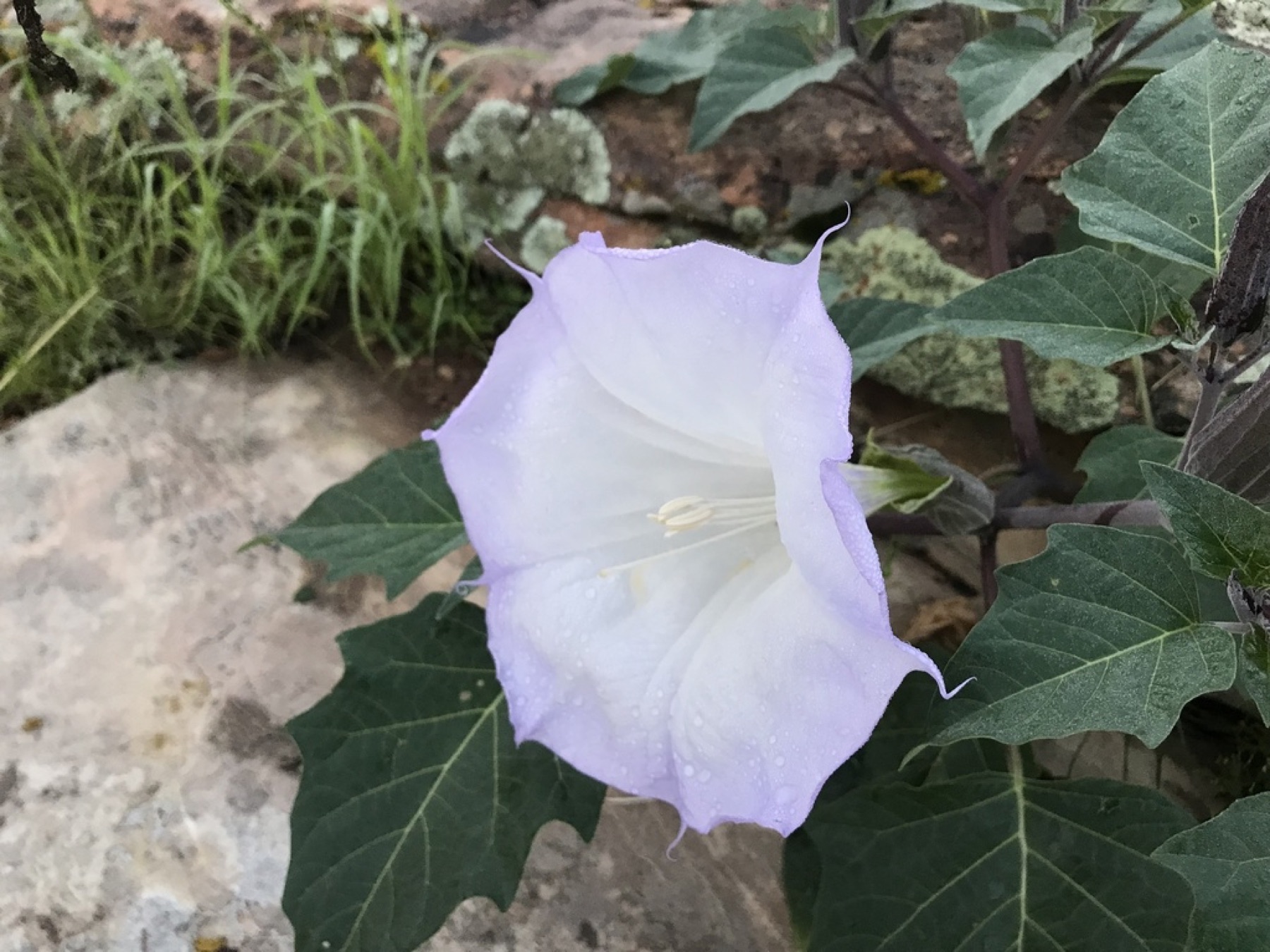 Sacred Datura 🌿 Datura wrightii more upright and weedy, with smaller flowers and jagged-toothed leaves; D. wrightii is greyer, low-spreading, with larger flowers and nearly entire leaf margins.