Western Serviceberry
Amelanchier alnifolia · Rosaceae
- Form
- Shrub
- Height
- 3–15 ft
- Sun
- Full Sun
- Water
- Low
- Blooms
- May, Jun
🌿 California native
Quick facts
- Habitat: Open Montane slopes, canyons, and Riparian edges
- Form / size: Suckering deciduous shrub, 3–15 ft
- Sun: Full sun · Water: Low
- Blooms: White strap-petaled spring flowers, sweet purple berries · Pollinator value: High
Description
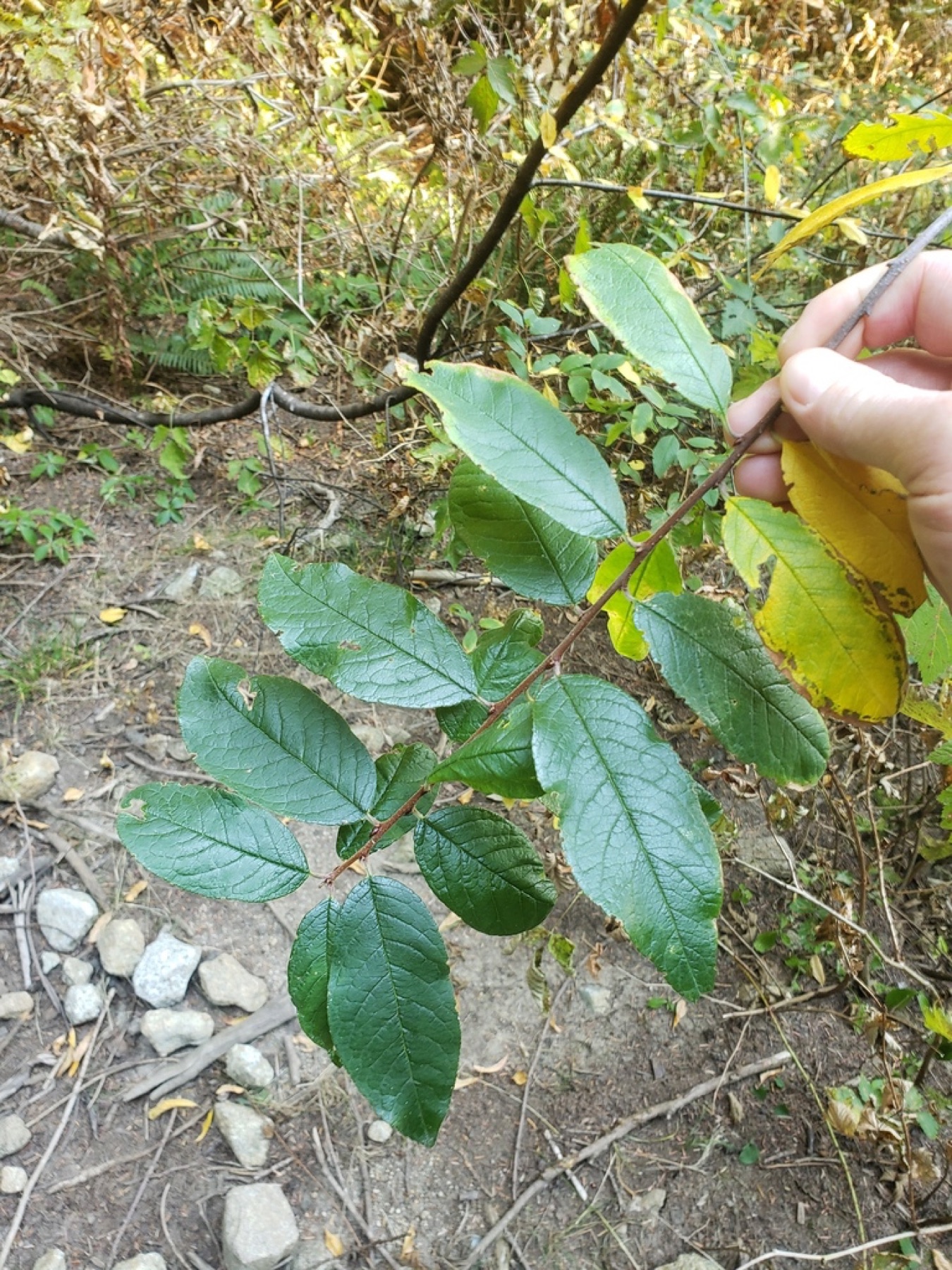
A multi-season mountain shrub, deciduous and often forming suckering thickets. Its oval to nearly round blue-green leaves are toothed mostly on the upper half and squared or rounded at the tip. In spring it carries white flowers with five narrow, strap-like petals in short upright clusters, an airy, loose look unlike the tight blossom of a wild rose or cherry. The fruit is a small purple-black pome with a whitish bloom, sweet and blueberry-like, crowned by the dried calyx, and the foliage turns orange-red in fall. In the Sierra it is the glabrous variety, pumila.
Indigenous & historical use
Across the northern Great Plains, within the plant’s range, the Blackfoot (Niitsitapi) treated serviceberries, okonoke, as a staple food, eating them fresh and drying them in quantity to pound into soups, stews, and pemmican for winter. The use is recorded in Hellson and Gadd’s Ethnobotany of the Blackfoot Indians (1974). This is the plant of the name “Saskatoon,” and its berries fed people over a huge stretch of the West.
Ecological role
Western serviceberry is a high-value wildlife shrub. Its spring flowers feed native bees, and it is a larval host for pale, two-tailed, and western tiger swallowtail butterflies; its summer berries are a major food for black bears, songbirds, and squirrels, while mule deer and elk browse the foliage heavily. It suckers readily into clonal thickets that provide cover and hold streambanks and slopes.
Habitat & range
Open slopes, canyons, and streamsides in the montane Sierra Nevada, roughly 4,500 to 8,500 ft. It grows through the Eastern Sierra in Mono County and the Mammoth Lakes area, and in the Tahoe-area mountains.
In the garden
An easy, adaptable landscape shrub with a real four-season payoff: white spring bloom, edible summer berries, and orange-red fall color. It takes full sun in the mountains and appreciates part shade at hotter, lower elevations, tolerates sand, loam, or clay, and needs only low water once established. Give it room to sucker, or site it as an informal hedge.
Propagation
From seed given about 90 to 120 days of cold-moist stratification after the pulp is cleaned off. It propagates readily from suckers and root division and from softwood or dormant hardwood cuttings, and low branches will layer where they touch soil.
Where to see it near you
- iNaturalist — observed across California (map)
- Open montane slopes of the Eastern Sierra (Mono County) and the Lake Tahoe area.
Sources
- Calscape · iNaturalist · Wikipedia
- Indigenous use: Hellson, J.C. & M. Gadd, Ethnobotany of the Blackfoot Indians (1974).