Common Silverweed
Argentina anserina · Rosaceae
- Form
- Perennial
- Height
- 4–8 in
- Sun
- Full Sun
- Water
- High
- Blooms
- May, Jun, Jul, Aug
🌿 California native
Quick facts
- Habitat: Wet meadows, lake margins, springs, ditch banks, damp sand
- Form / size: Flat mat-forming perennial, 4–8 in, spreading by runners
- Sun: Full sun · Water: High — it grows where the ground stays wet
- Blooms: Late spring through summer · Pollinator value: Moderate
Description
A ground-hugging perennial that runs across wet open ground on long red stolons, exactly the way a strawberry does, rooting down wherever a node touches soil. A single plant can throw runners two and a half feet out and build a loose mat in one season.
The leaf is the whole identification. It is evenly pinnate — a long central stalk with saw-toothed leaflets in two rows down either side, six to fourteen teeth per side, the whole leaf four to eight inches long. Between the full-size leaflets sit much smaller ones, so the leaf reads as alternating large-small-large-small along its length, which is a useful signature once you’ve seen it. Silky white hairs cover the plant, thickest on the leaf undersides. Flip a leaf over: the back is distinctly silver, sometimes almost white, against a plain green top. That contrast is where the name comes from and it is visible from standing height.
Flowers come one to a stalk on a bare leafless stem, about an inch across, with five rounded yellow petals. One flower per stem, never a cluster.
Ecological role
Silverweed is a soil-holder. Its stolon mats knit together the loose, seasonally saturated ground at lake margins and meadow edges where water levels rise and fall, the exact places that erode when the plant cover goes. It tolerates both flooding and the summer drawdown that follows, which is why it persists on shorelines where most perennials cannot.
The flowers are open and shallow, so they feed short-tongued bees, hoverflies, and small beetles rather than the long-tongued specialists that work tubular flowers. Geese and other waterfowl graze the foliage and dig the starchy roots, and the plant’s old epithet points straight at that relationship — anserina comes from anser, the Latin for goose.
Habitat & range
Wet meadows, spring seeps, streambanks, lakeshores, ditch banks, and damp sandy or gravelly ground, native across the temperate Northern Hemisphere and through most of California. In the San Bernardino Mountains it stays with reliable water, so around Big Bear expect it on the lake margin, in wet meadow turf, and along the damp edges of roads and drainages rather than out on the dry slopes.
Indigenous & historical use
The substantial documented food record for silverweed in western North America belongs to the coastal plant, not this inland one. Nancy Turner and Harriet Kuhnlein’s 1982 study in Economic Botany documents Pacific silverweed (Potentilla anserina ssp. pacifica, now usually treated as Argentina egedii) as one of the two most important cultivated root foods of Northwest Coast peoples, harvested in fall from tended, owned estuary plots, then steamed, dried, and stored or traded. That is a different plant on a different coast, and no comparable record turned up for the inland silverweed of the Southern California mountains. The starchy-root tradition is real and well sourced; it just doesn’t attach to the plant growing at Big Bear.
In the garden
Easy to the point of being pushy. Give it a pond edge, bog garden, or any low spot that stays wet and it will fill in fast and hold the bank. In an irrigated bed it will run into places you didn’t plan for, so contain it or site it where a spreading mat is the point. Full sun, no fertilizer needed.
Propagation
The simplest propagation in this guide. Find a rooted plantlet on a runner, cut the stolon on either side, and lift it with its roots — it transplants at almost any time in the growing season as long as it stays wet. Division of an established crown works the same way. From seed, give 30 to 60 days of cold-moist stratification and surface-sow into wet soil, but there is rarely a reason to bother. See Propagation Basics.
Where to see it near you
- iNaturalist — observed across California (map)
- Wet meadow and lake-margin ground around Big Bear.
Sources
Commonly confused with
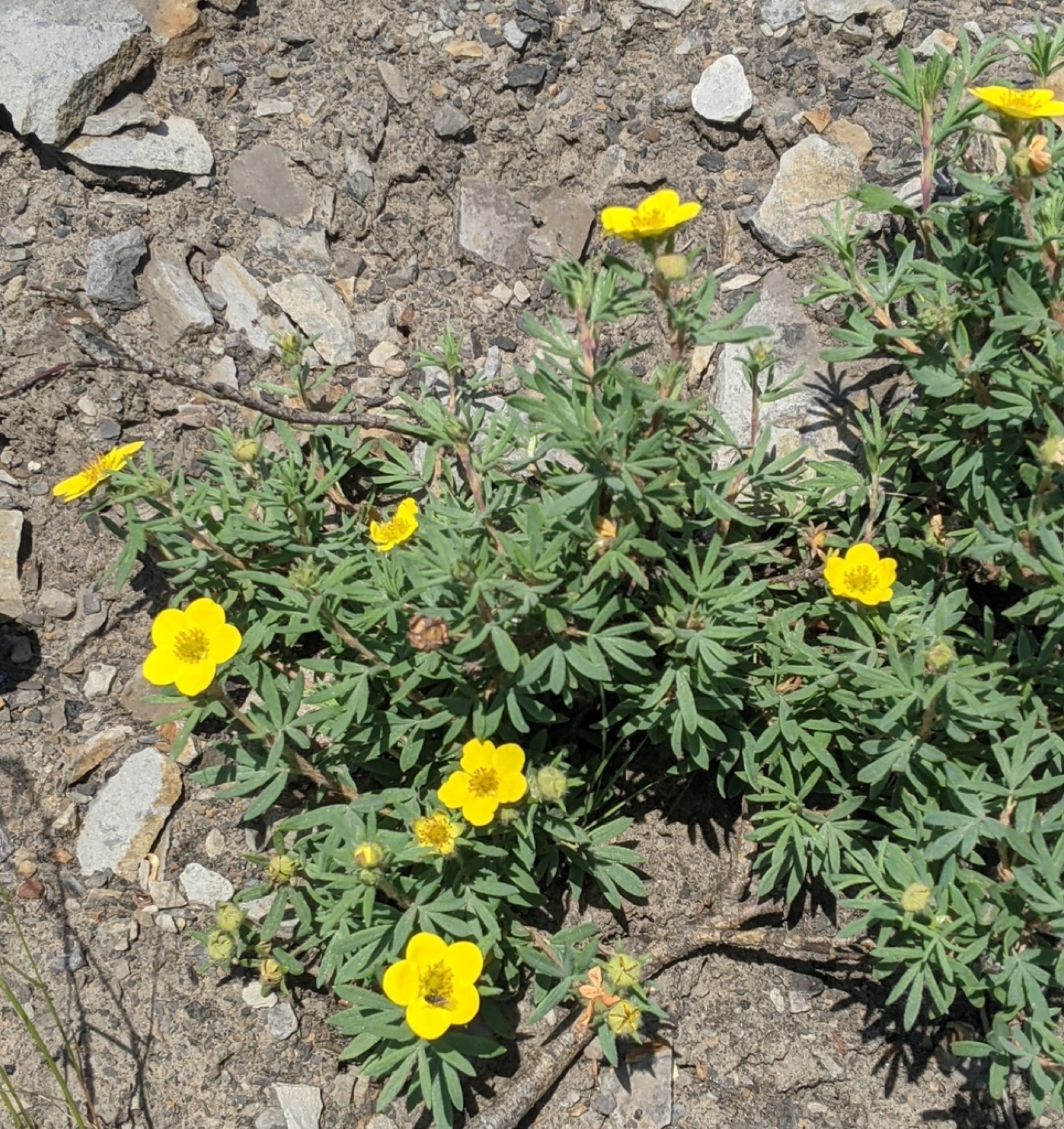 Shrubby Cinquefoil 🌿 Dasiphora fruticosa same family, same yellow five-petaled flower, same wet montane meadows. It is a knee-high woody shrub with shreddy bark and tiny gray-green leaflets, where silverweed is a flat herb you look down at. If you can snap a woody twig, it isn't silverweed.