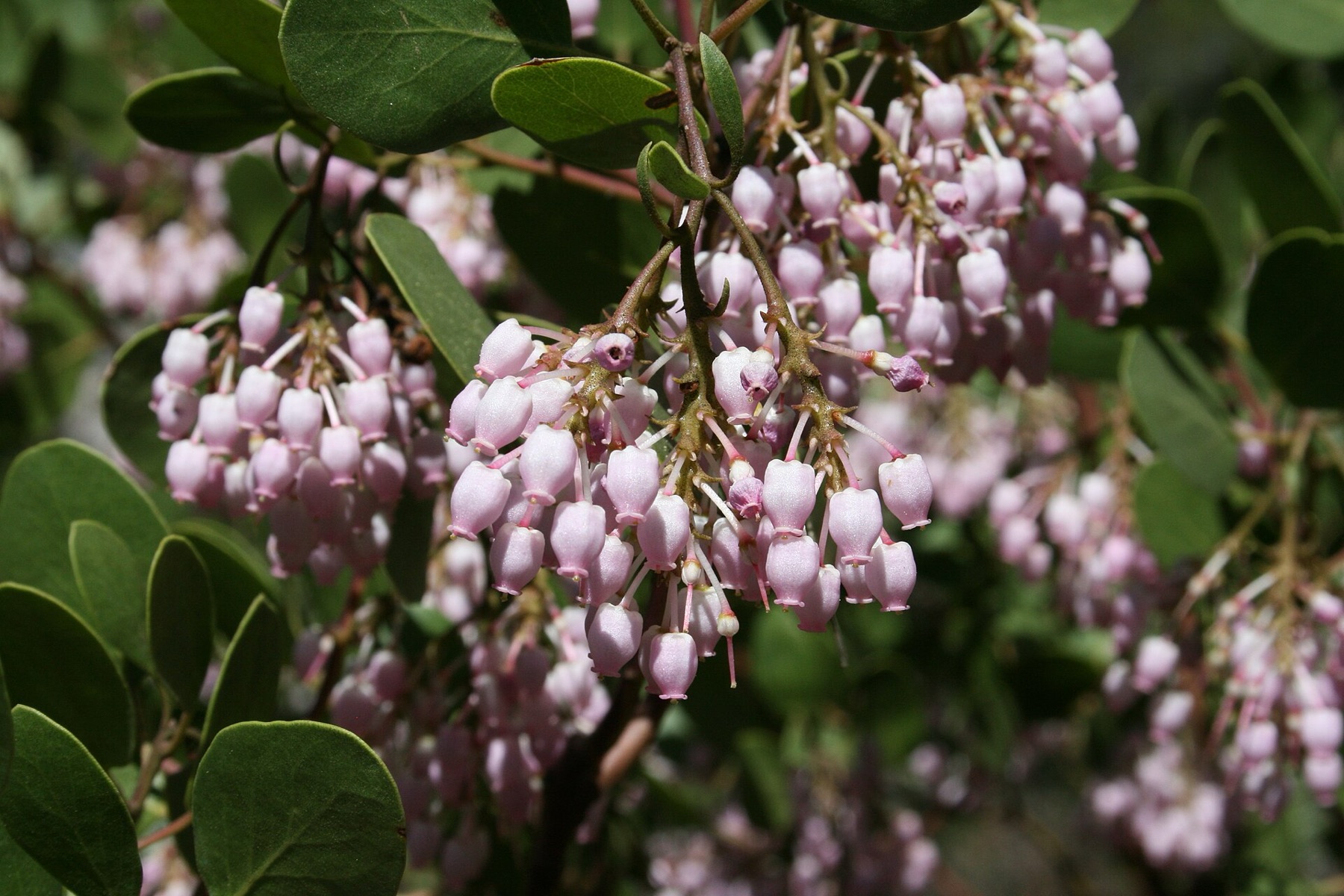
San Gabriel Beardtongue
Penstemon labrosus · Plantaginaceae
- Form
- Perennial
- Height
- 1–2.5 ft
- Sun
- Full Sun
- Water
- Low
- Blooms
- Jun, Jul, Aug, Sep
- Habitat
- Montane
🌿 California native
Quick facts
- Habitat: Montane conifer forest openings, granitic slopes, road cuts
- Form / size: Slender upright perennial, 1–2.5 ft
- Sun: Full sun · Water: Low
- Blooms: Midsummer into early fall — scarlet tubes · Pollinator value: High
Description
A thin, wiry perennial that holds its flowers well above the foliage on nearly bare stems, so from a distance it reads as red sparks floating over granite. The leaves are opposite (strictly paired), long and narrow to the point of looking grass-like, over three inches on a good plant, with untoothed edges that roll under. Everything about the plant is hairless — no fuzz on the stems, no glandular stickiness on the flower stalks, nothing to catch the light.
The flower is the giveaway. It runs 3 to 4 cm long, bright scarlet to orange (occasionally washing out toward yellow), with a hooded upper lip and a lower lip split into three narrow lobes that curl sharply backward, leaving the mouth of the tube wide open. Even the staminode (the sterile fifth stamen that gives “beardtongue” its name) is bare in this species, with none of the fuzz you find in most penstemons.
Ecological role
This is a hummingbird plant, built for it down to the details. The long scarlet tube, the lack of a landing platform, and the absence of nectar guides are all the classic signature of bird pollination — a bee gets little out of a flower shaped this way, and mostly doesn’t bother. It blooms from June into September, which lines it up with the summer hummingbird season in the San Bernardino Mountains and with Anna’s and rufous hummingbirds moving through the high country.
It is also a disturbance specialist in the mildest sense. It shows up readily on road cuts, decomposed granite banks, and burn openings, colonizing raw mineral soil where the forest floor has been scraped away. That habit makes it one of the first things to bring color back to a slope after a fire or a grading job, and it is a good indicator that a site is recovering rather than eroding.
Habitat & range
Granitic slopes and openings in yellow pine, red fir, and lodgepole forest through the Transverse Ranges (the San Gabriel and San Bernardino Mountains), and south through the Peninsular Ranges into Baja California, where it grows above about 5,000 ft in the Sierra de Juárez and the Sierra de San Pedro Mártir. It is a genuinely southern California plant, not a Sierra Nevada one, which is part of what makes it worth knowing around Big Bear.
In the garden
One of the better red penstemons for a cold mountain garden, and it wants exactly what it gets in the wild: full sun, lean gritty soil, and sharp drainage. It resents rich beds and summer irrigation, both of which shorten its life. Plant it on a slope or in a raised gravel bed, leave the seed heads until spring, and let it reseed into the gaps. Reliable hummingbird draw from June on.
Propagation
From seed, which needs 8 to 12 weeks of cold-moist stratification — sow in fall into a gritty mix and leave the pot outdoors over winter, or refrigerate damp seed in a bag before a spring sowing. Softwood cuttings taken from non-flowering shoots in early summer root in coarse sand with good humidity. Divisions are unreliable; this is a plant with a woody crown that does not like being torn apart.
Where to see it near you
- iNaturalist — observed across California (map)
- Road cuts and forest openings around Big Bear, and across the San Bernardino National Forest.
Sources
- Calscape · iNaturalist · Wikipedia · Calflora
Commonly confused with
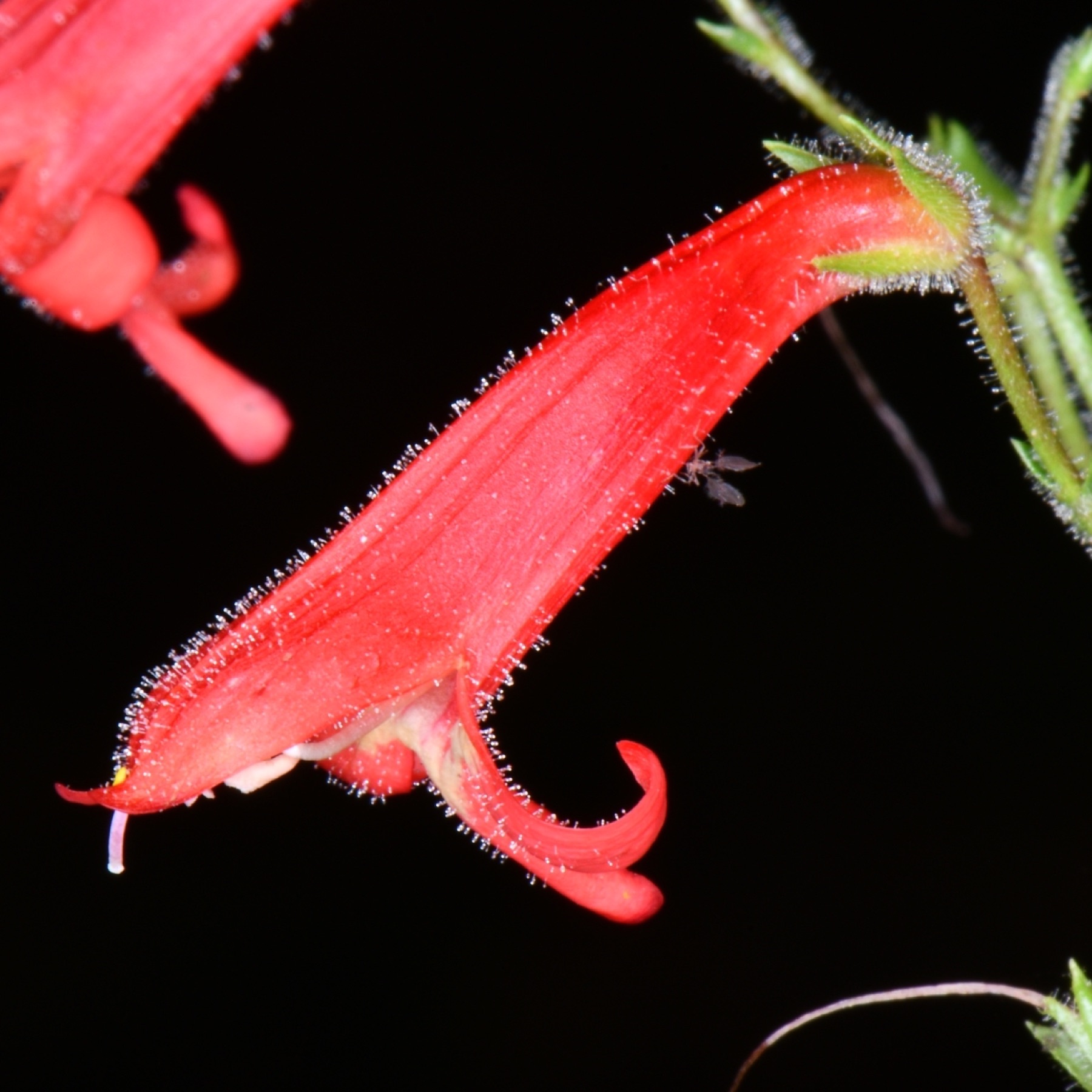 Bridges' Penstemon 🌿 Penstemon rostriflorus the hard one, because both are scarlet penstemons that overlap in the San Bernardinos. Go to the base of the plant and the leaves. Bridges' penstemon is woody at the bottom, a small subshrub with a persistent stem you can feel, and its leaves are short (under 2 in) and widest above the middle, spear-head-shaped. San Gabriel beardtongue stays herbaceous to the ground and its leaves are long, narrow, and parallel-sided, nearly grass-like. Then check the flower stalks with a hand lens: Bridges' penstemon is usually glandular-hairy and sticky toward the tips of the inflorescence, while San Gabriel beardtongue is hairless throughout. Bridges' also pushes its staminode out past the flower mouth like a tongue.
 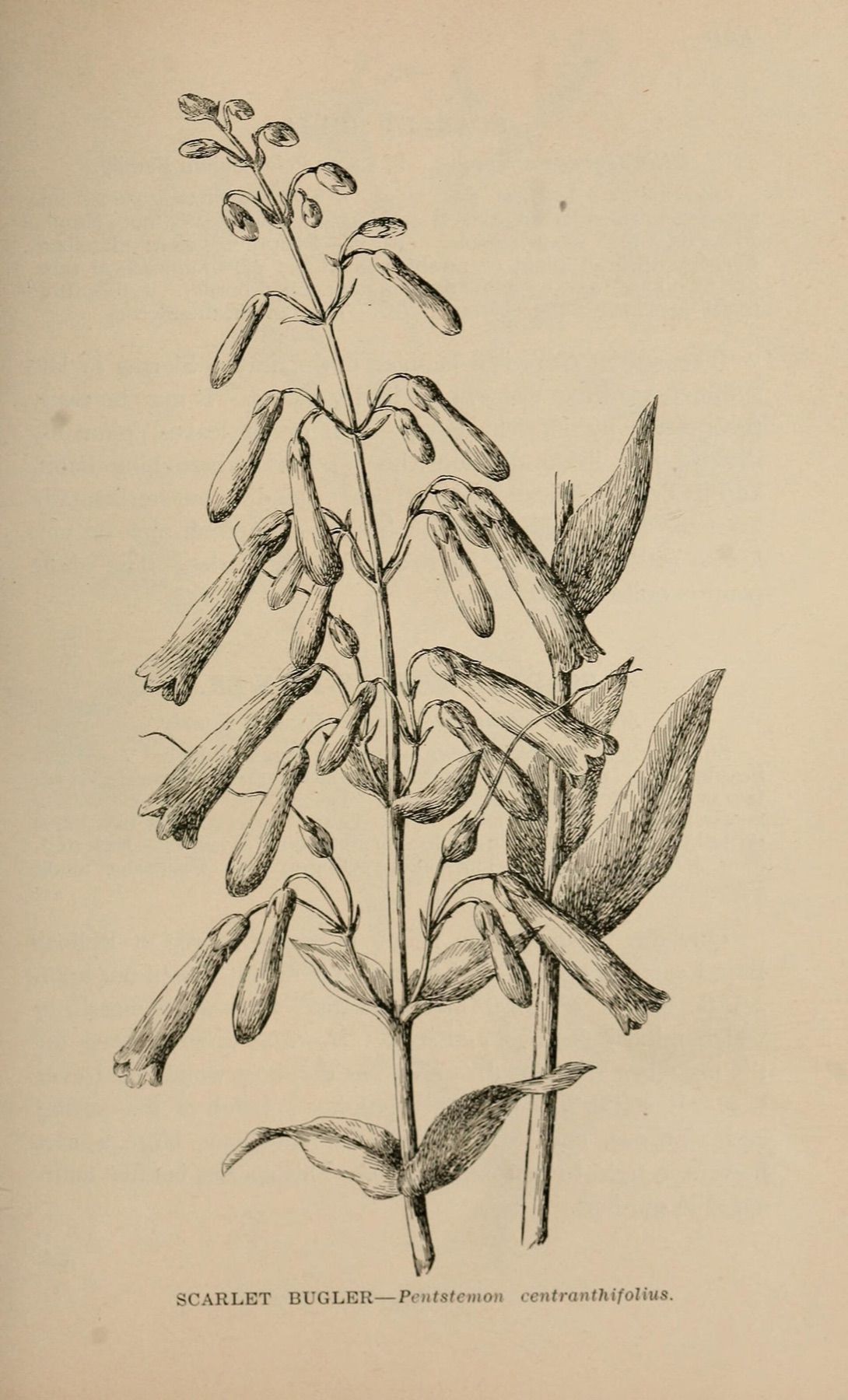 Scarlet Bugler 🌿 Penstemon centranthifolius a lower-elevation chaparral plant, so mostly an elevation problem rather than a look-alike one, but the leaves settle it instantly. Scarlet bugler has broad blue-green leaves that clasp the stem, and its flowers are narrow tubes with barely any lips at all, more like a straw than an open mouth.
 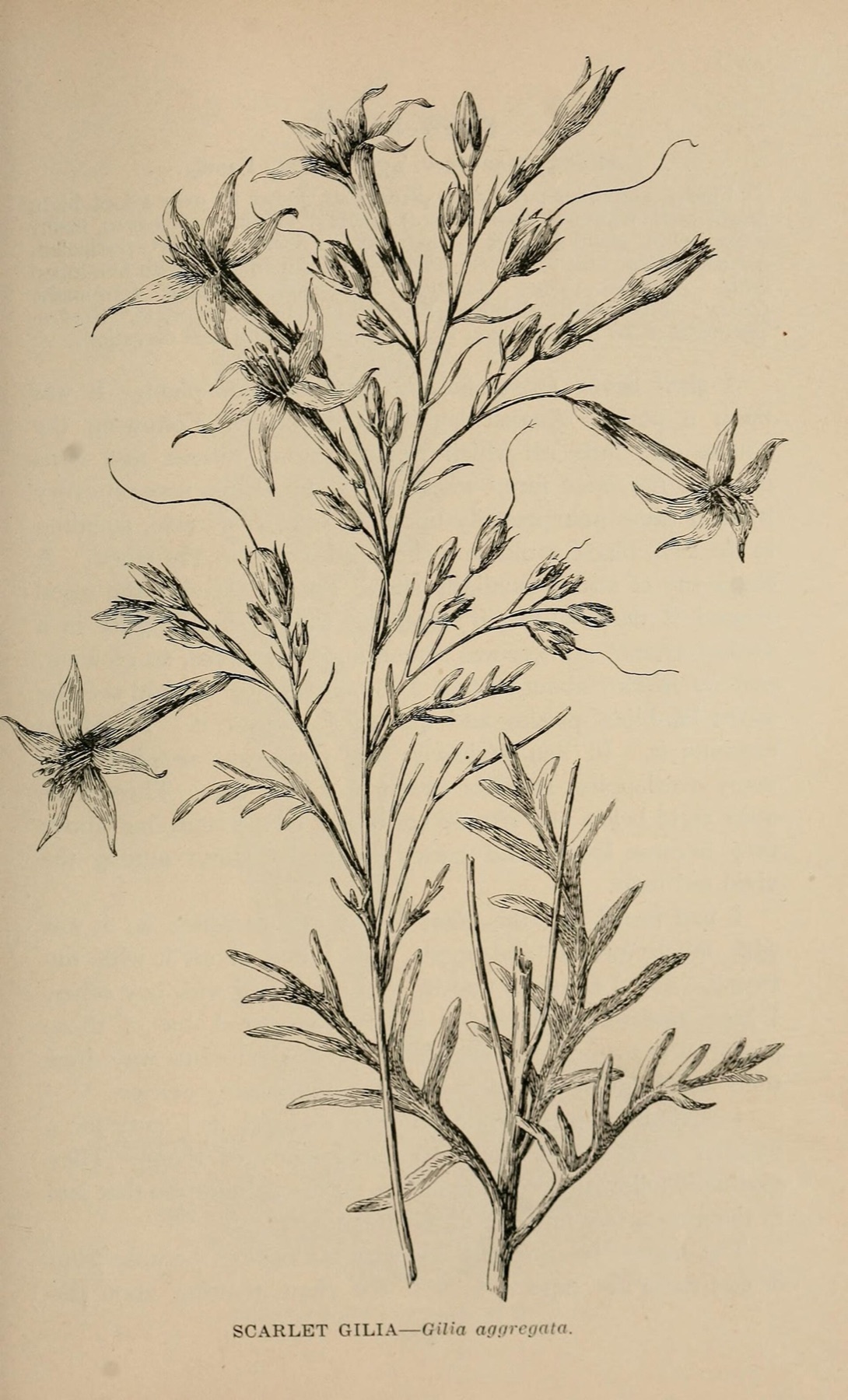 Scarlet Gilia 🌿 Ipomopsis aggregata same red trumpet, same season, same dry montane ground. The leaves are the split: scarlet gilia's are finely dissected and feathery, like a small carrot top, versus the penstemon's plain narrow blades. Crush a leaf — scarlet gilia smells skunky, and penstemon smells like nothing.